
CatFlow
Co-generation of Slab–Adsorbate Systems via Flow Matching
Overview
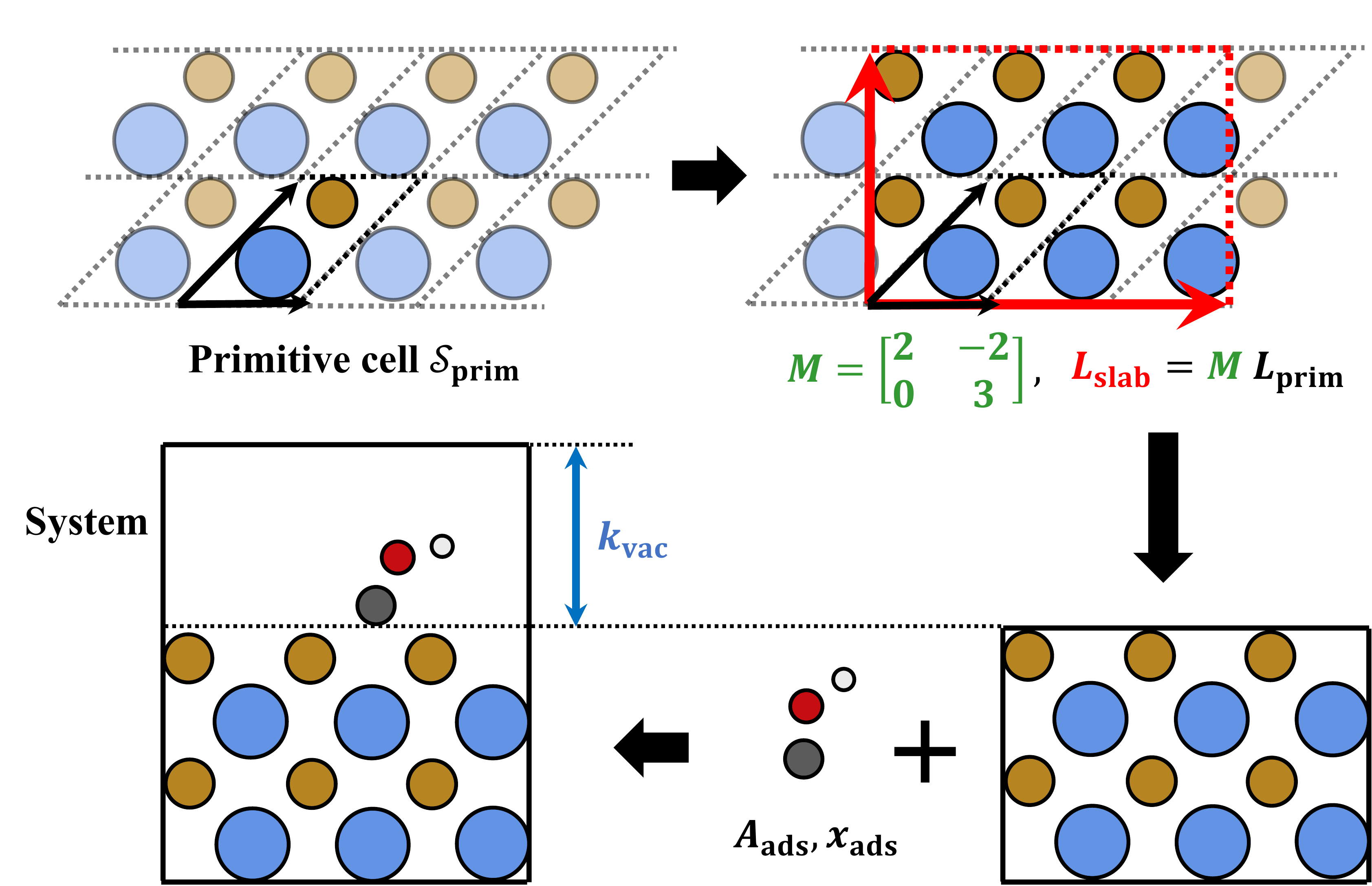
CatFlow co-generates slab structures and adsorbate configurations at the all-atom level via flow matching. A factorized representation reduces the modeling dimensionality of the slab-adsorbate system, and CatFlow outperforms baselines on both de novo generation and structure prediction over OC20. The model also demonstrates the capability for global minimum search.
Generation & relaxation
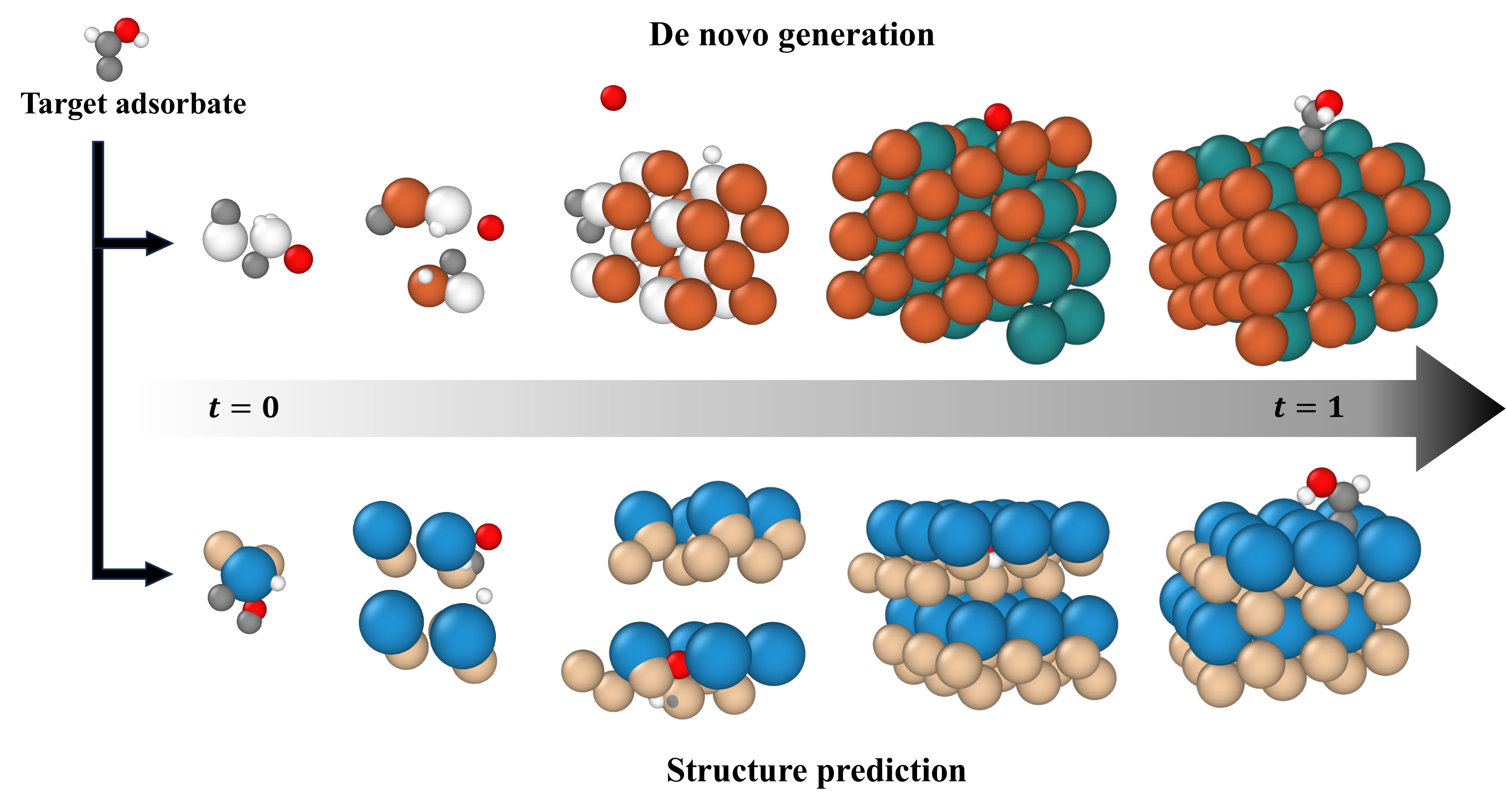
CatFlow generates a slab–adsorbate system through a continuous-and-discrete flow-matching trajectory, then relaxes the structure with UMA-s-1p1. Relaxation drives the sample toward a thermodynamic local minimum.
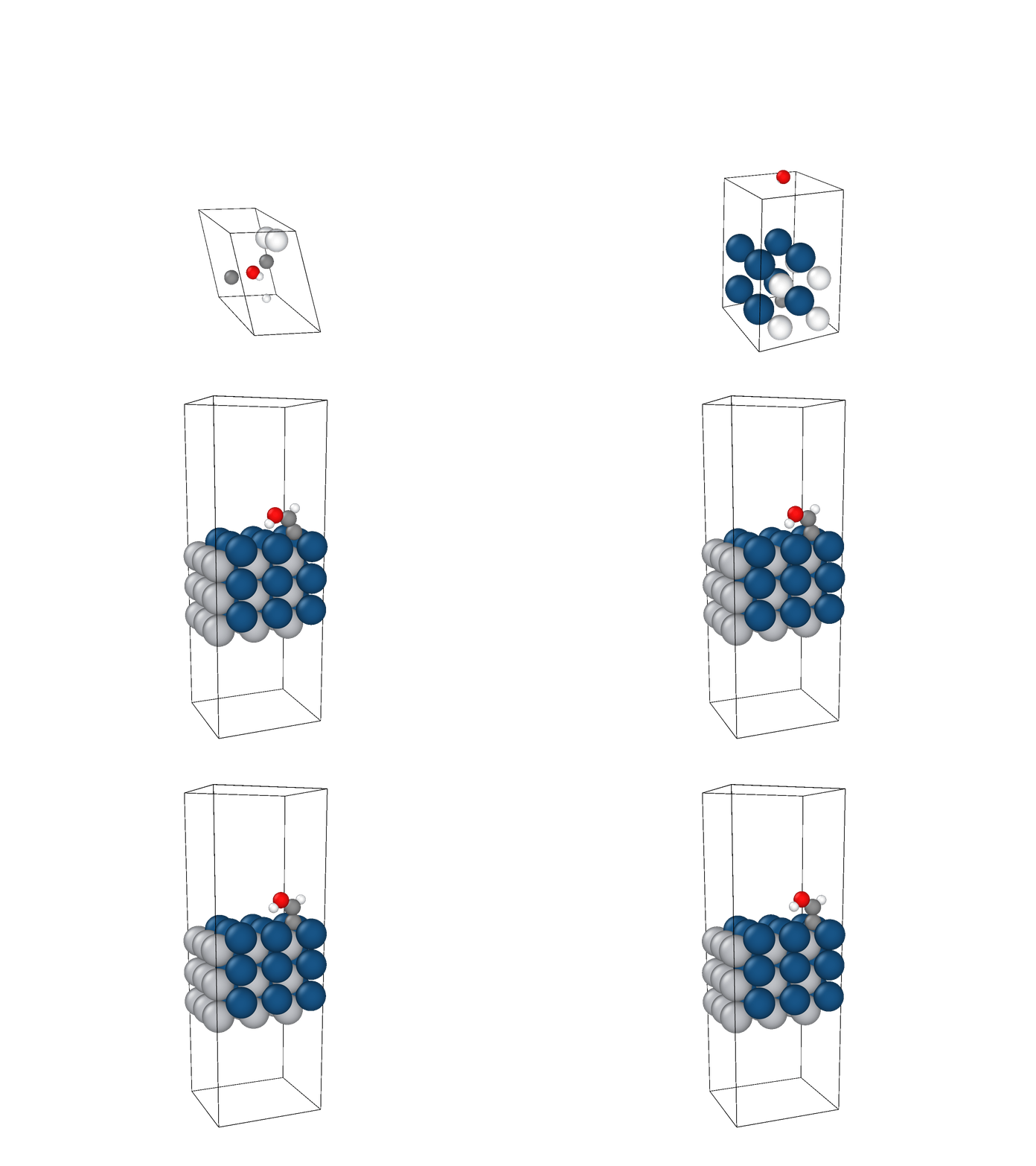
Adsorption energy before and after relaxation. A negative relaxed Eads indicates a thermodynamically favorable adsorption configuration.
Interactive viewer
Drag to rotate · scroll or pinch to zoom · atoms coloured by element.
Concept
Co-generation trajectory
Citation
If you find CatFlow useful, please cite:
@article{kim2026catflow,
  title   = {CatFlow: Co-generation of Slab--Adsorbate Systems via Flow Matching},
  author  = {Kim, Minkyu and Kim, Nayoung and Kim, Honghui and Ahn, Sungsoo},
  journal = {arXiv preprint arXiv:2602.05372},
  year    = {2026}
}